


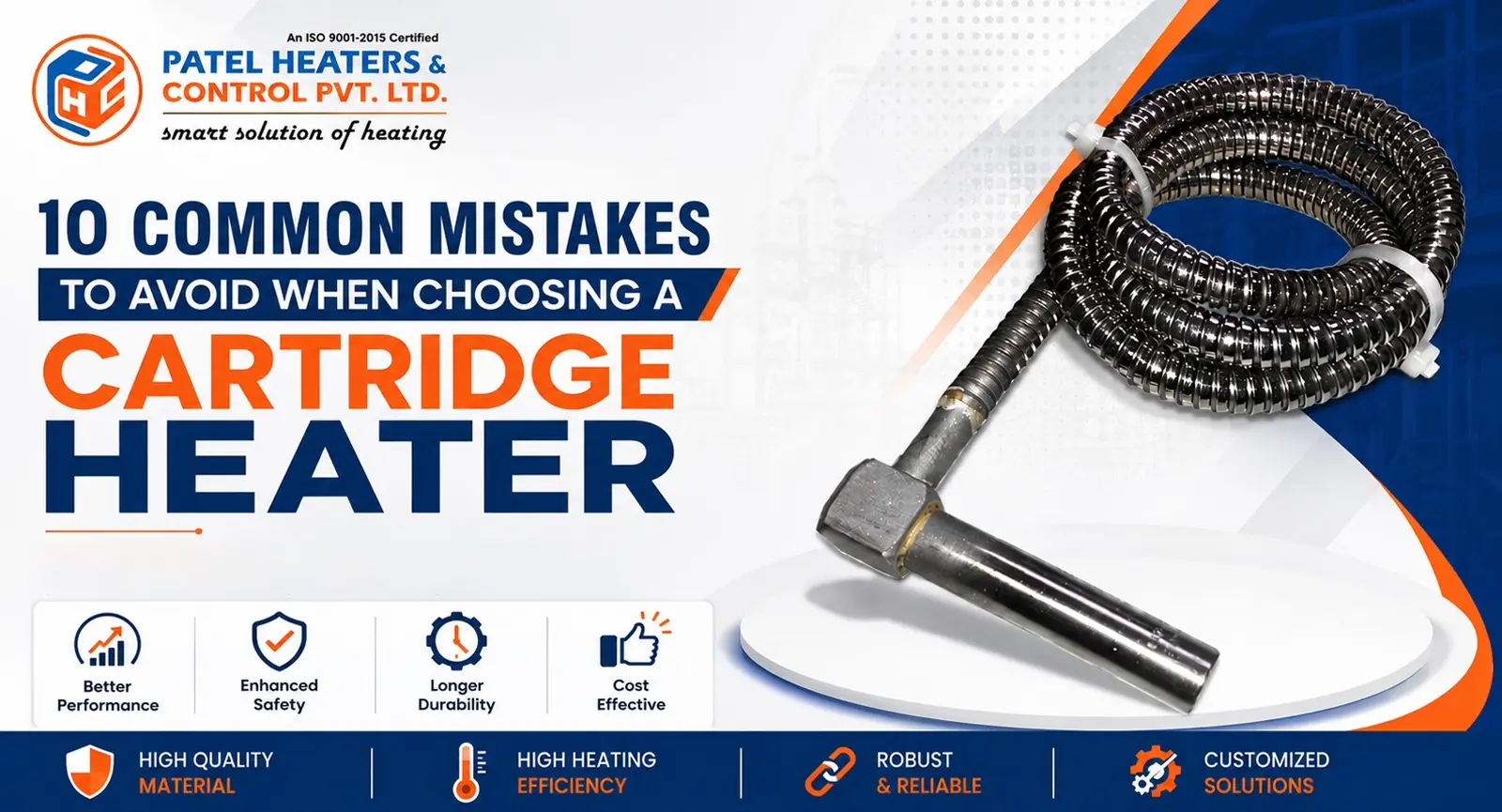
10 Common Mistakes to Avoid When Choosing a Cartridge Heater
Overview – The most common mistakes people make when choosing a cartridge heater include picking the wrong watt density, choosing a heater that doesn’t fit snugly in the hole, ignoring lead wire and termination type, skipping thermocouple placement, and focusing on price over build quality. Each of these seems minor on its own, but together they’re responsible for most premature heater failures in industrial settings. Getting the sizing, watt density, termination, and sheath material right the first time saves both money and downtime later.
This Blog Covers:
- Introduction
- Not Understanding the Application Requirements
- Ignoring Watt Density
- Choosing the Wrong Size or Fit
- Overlooking Lead Wire and Insulation Type
- Skipping the Right Termination Style
- Ignoring Thermocouple Placement
- Not Accounting for Unheated Length
- Overlooking Sheath Material and Environment
- Poor Mounting and Vibration Protection
- Choosing Price Over Quality
- Built to Perform, Made to Last
- Frequently Asked Questions
Introduction
A cartridge heater looks like a simple part, a metal cylinder that generates heat when power runs through it. But choosing the right one for your application involves more decisions than most buyers expect. Get even one of them wrong, and you end up with uneven heating, early failure, or a heater that just doesn’t perform the way it should. Here are ten mistakes worth avoiding before you place an order.
Not Understanding the Application Requirements
Before you look at specifications, you need to know exactly what you’re heating, how hot it needs to get, and how fast. A cartridge heater picked without this groundwork often ends up mismatched to the job, either underperforming or burning out early. Talk through the actual application with your supplier before settling on a spec sheet.
Ignoring Watt Density
Watt density is how much heat a cartridge heater puts out per unit of surface area, and it’s one of the most important numbers in the entire selection process. Too high, and the heater runs hotter than the application or the material can handle, shortening its life. Too low, and it simply can’t deliver the heat you need fast enough. Getting this number right depends on the material being heated and how quickly that heat needs to transfer.
Choosing the Wrong Size or Fit
Getting the diameter and length exactly right, down to fractions of an inch, matters more than people expect. It has to be placed inside its drilled hole perfectly. Too loose, and there’s an air gap between the heater and the metal, which weakens heat transfer and creates hot spots. Too tight, and the heater can be difficult to insert or remove for maintenance.
Overlooking Lead Wire and Insulation Type
The wires coming out of a cartridge heater need to handle the environment they’re working in, not just the heat inside the application. Moisture, chemicals, or physical abrasion around the installation point can degrade the wrong lead wire quickly. Materials like MGT wire rated for high temperatures, along with the right outer protection, need to match the actual working conditions, not just the heater’s core specs.
Skipping the Right Termination Style
Cartridge heaters come with different termination options: crimped-on leads, swaged-in leads, stainless steel braid, or armoured cable, and each is suited to a different kind of use. A heater that needs to flex or move during operation needs a flexible termination style; one that stays static doesn’t. Choosing based on convenience rather than actual movement and space requirements is a mistake that shows up as lead failure down the line.
Ignoring Thermocouple Placement
For applications where precise temperature control matters, an internal thermocouple isn’t optional. Where it’s placed inside the heater, grounded or ungrounded, at the center or at the disc end, affects how quickly and accurately it reads temperature. Skipping this consideration, or defaulting to whatever’s cheapest, often means slower response times and less consistent heating.
Not Accounting for Unheated Length
Every heater needs a small unheated section near the lead exit point, and this length varies depending on the heater’s diameter. Ignoring this detail during design can lead to leads that overheat prematurely or a heater that doesn’t fit the application the way it was meant to. It’s a small technical detail that gets overlooked more often than it should.
Overlooking Sheath Material and Environment
The outer sheath of the heater is what stands between the heating element and whatever environment it’s working in. If the application involves moisture, chemical exposure, or contact with corrosive materials, the sheath material needs to be chosen accordingly. Using a standard sheath in a harsh environment is a common reason cartridge heaters fail well before their expected service life.
Poor Mounting and Vibration Protection
In applications with vibration or movement, the heater can work its way loose from its hole over time if it isn’t properly secured. Mounting flanges are built specifically to prevent this, and skipping them in a vibration-prone setup is a mistake that often only becomes obvious after the heater has already failed or fallen out.
Choosing Price Over Quality
It’s preferred to go with whichever cartridge heater costs the least, but a poorly made one usually fails sooner, leading to more frequent replacements and unplanned downtime. A slightly higher upfront cost for a well-built heater, from a manufacturer that tests before shipping, usually works out cheaper over the equipment’s working life.
Built to Perform, Made to Last
Patel Heaters & Control Pvt. Ltd., based in Vadodara, Gujarat, has been manufacturing industrial heating equipment since 1982. Our cartridge heaters are built with helically coiled nickel chrome or Kanthal resistance wire, packed with high-purity magnesium oxide for efficient heat transfer, and available with watt densities up to 50 watts per centimeter, along with a range of termination styles, lead protections, and thermocouple configurations to match specific applications. For help specifying the right heater for your equipment, get in touch with the Patel Heaters team.
Frequently Asked Questions
Watt density is the amount of heat a heater produces per unit of surface area. Setting it too high shortens the heater’s life, while too low means it can’t heat fast enough for the application.
You’ll need the exact diameter and length of the hole it’s going into, along with the required voltage and wattage. A snug fit is critical for good heat transfer, so precise measurements matter more than rough estimates.
Not all, but any application needing precise, consistent temperature control benefits significantly from one. Skipping it usually means slower and less accurate temperature response.
Because they’re often what fails first. The wrong termination style for a vibrating or flexing application, or the wrong insulation for a harsh environment, leads to premature failure even if the heater itself is well made.

Patel Heaters
Patel Heaters and Control has immense expertise in the manufacturing of Industrial heaters and heating elements. We have been providing heating solutions to our clients since 1982.