

How to Select the Best Infrared Heater for Your Industry
Most people don’t think much about an Infrared Heater until they’re buying one for the first time. Then they realize there are multiple types, different wavelength ranges, wattage considerations, and material compatibility factors to work through. Pick the wrong one and it either underperforms or fails early.
This guide walks you through what actually matters when selecting an infrared heater for industrial use, without overcomplicating it.
How an Infrared Heater Actually Works
Before getting into selection, it helps to understand what makes infrared heating different from conventional heating.
Convection heaters warm the overall air in a room and then circulate it to increase the temperature. This heating process can be less efficient, as warm air can travel through empty spaces, resulting in heat loss. Infrared heaters directly warm objects and people in a room, rather than heating the air.
In an industrial setting, this matters a lot. You’re not trying to heat a room. You’re trying to heat a specific material, surface, or product moving through a process. Infrared does that precisely and efficiently, which is why infrared heating is considered the most energy-efficient method for industrial applications, as it provides direct heat to objects and surfaces without warming the surrounding air.
Understanding the Types of Infrared Heaters
There are three types you’ll come across most often in industrial use. The difference between them isn’t just build material. It comes down to wavelength, and wavelength is what determines whether your material actually absorbs the heat properly or just sits in front of a heater doing nothing useful.
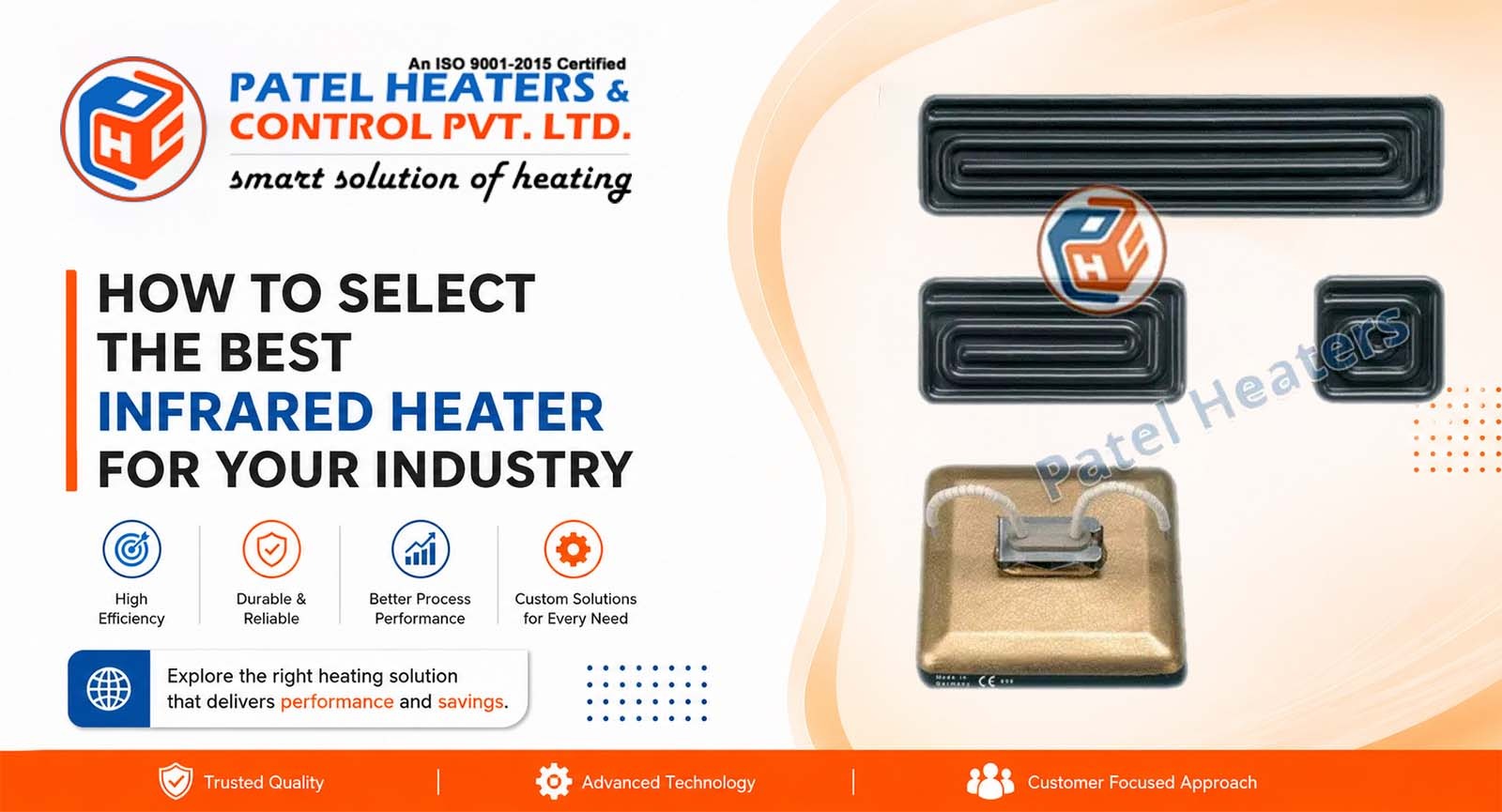
Quartz infrared heaters emit short-wavelength energy and produce intense, focused heat. That makes them the right choice for high-temperature processes—glass manufacturing, plastic thermoforming, and paint curing being the most common ones. If your process needs the heater to reach temperature quickly and respond to start-stop cycles without lag, quartz is usually what you want.
Ceramic infrared heaters are the more common choice across general industrial applications. They run at lower surface temperatures, which means less risk of surface damage or scorching. With their medium-wavelength output, they are commonly used for drying, curing, and heating in applications ranging from packaging to plastics and textile processing. They’re also more cost-effective and hold up better over time in stable environments.
Metal-sheathed infrared heaters offer the greatest durability and are engineered for demanding environments, including ovens and submersible heating applications. If the heater is going somewhere wet, chemically aggressive, or physically rough, metal-sheathed is the one that won’t give up on you in six months.
Matching the Heater to Your Industry
This is where most people make the actual buying decision, and it’s worth being specific rather than just going with whatever is cheapest or most available.
In food processing, inconsistent heat shows up in the product. Overcooked in one area, underdone in another. Infrared heating is widely used on cooking and drying lines precisely because it delivers even heat directly to the product rather than heating the surrounding air unevenly. Ceramic heaters are well suited here — controlled output, no sudden spikes, and gentle enough for the sensitivity most food products require.
Automotive paint lines run fast and don’t tolerate much variation in finish quality. Infrared heating fits well here because it accelerates curing without compromising the finish and does it more efficiently than conventional ovens. Short-wave quartz is what most paint lines specify. The response time is fast, the heat output is intense, and on a high-throughput line those two things matter more than almost anything else.
Plastics processing needs more care when selecting an infrared heater because different polymers absorb heat at different wavelengths. Get it right and infrared heating reduces cycle times, lowers energy consumption, and keeps product quality consistent. For thermoforming applications, ceramic emitters operating in the 2.5 to 6 micrometre range are the reliable choice. Getting the wavelength right for your specific material makes more of a difference here than in most other applications.
Textile and paper processing needs steady, consistent heat without the intensity that would damage the material. Medium-wave ceramic heaters are the go-to for fabric-drying and paper-processing lines, and they’re also widely used in electronics assembly for the same reason—controlled heat and no sudden spikes.
Key Factors to Consider Before Buying
Once you know which type suits your process, there are a few practical factors to confirm before finalizing.
- Wavelength and material compatibility. The wavelength of infrared energy produced depends on operating temperature. The higher the temperature of an object, the shorter the wavelength of energy it produces, and the higher the energy output. Match the heater’s wavelength output to the absorption characteristics of your material. A mismatch means poor heat transfer and wasted energy.
- Wattage. The power of the heater is directly proportional to its ability to heat different objects. The power is measured in watts, and it is vital to choose the correct wattage to achieve the desired result of the heating efficiency. Too low and the process slows down. Too high and you risk material damage.
- Environment and durability. If the heater is going into a wet, chemical-heavy, or physically demanding environment, build material matters. Quartz is fragile. Ceramic is more robust. Metal-sheathed handles the most demanding conditions.
- Response time. Processes that require rapid heat-up and cool-down cycles need short-wave heaters. Processes that need steady, continuous heat do fine with ceramic or medium-wave options.
- Custom sizing. Standard sizes don’t always fit. Many industrial setups require heaters built to specific dimensions to fit existing equipment or line configurations.
Why Getting This Right Matters?
A wrong heater selection rarely makes itself obvious straight away. What you notice instead is uneven heating, higher energy use than expected, or heaters burning out ahead of schedule. None of that is bad luck. It’s the result of a heater spec that doesn’t match what the process actually needs.
Patel Heaters & Control Pvt. Ltd. manufactures ceramic, quartz, and metal-sheathed infrared heaters for industrial use. The heaters go into plastics, rubber, pharmaceutical, chemical, glass, and textile applications. Built to ISO 9001 standards with high-grade components, and available in custom sizes and configurations to fit your specific process and equipment.
Frequently Asked Questions
Short-wave heaters operate at higher temperatures, respond quickly, and are suited to high-intensity processes like paint curing and thermoforming. Medium-wave heaters run at lower surface temperatures, provide more even heat distribution, and are better suited to drying, textile processing, and applications where material sensitivity is a concern.
Not always. Different materials absorb infrared energy at different wavelengths. What works well for one polymer may be inefficient for another. If your process handles multiple materials, it’s worth confirming wavelength compatibility for each before settling on a single heater type.
Start with the heat-up rate your process requires and the surface area being heated. A supplier with application experience can calculate the required watt density from those inputs. Oversizing the wattage is a common mistake that leads to surface damage and wasted energy.
Most industrial infrared heaters run on standard single-phase or three-phase supply depending on the wattage. For precise process control, a compatible temperature controller is recommended. This allows you to regulate heat output, prevent overheating, and extend heater life.

Patel Heaters
Patel Heaters and Control has immense expertise in the manufacturing of Industrial heaters and heating elements. We have been providing heating solutions to our clients since 1982.